Toy Manufacturing Blog and Industry Insights
VietnamToy Knowledge Hub

Toy Manufacturing Blog & Insights

Industry guides, compliance updates, OEM/ODM processes & global supply chain strategies.

Custom OEM ODM Toy Manufacturing Guides
Manufacturing Expertise

OEM & ODM Production Guides

Learn how to take your custom toy designs from initial concept to mass production in Vietnam.

Toy Safety Standards EN71 ASTM CPSIA
Compliance & Quality

Global Safety Certifications

In-depth analysis of EN71, ASTM F963, and CPSIA compliance for international buyers.

0%

Choosing the right toys for babies and toddlers can feel surprisingly difficult. Bright packaging often promises learning, creativity, and faster development. Yet meaningful play usually needs less noise and more thoughtful design. A simple wooden sorter, soft stacking cups, or a picture book can hold a child’s attention longer than an electronic gadget.

Developmental psychologist Dr. Kathy Hirsh-Pasek has said, “Playful learning is not an oxymoron.” That idea guides this selection of Educational Baby & Toddler Toys. The best choices invite children to touch, move, notice, repeat, and solve small problems. They should match a child’s age, abilities, and changing interests. Safe materials, secure parts, washable surfaces, and clear age guidance also matter. These details are easy to overlook.

No toy works perfectly for every child. A carefully chosen puzzle may be ignored today and explored next month. A costly product may receive less attention than an empty cardboard box. That is normal, and it deserves honest consideration. Children learn through repetition, movement, conversation, and shared attention, not through toys alone. Caregivers still provide the most valuable support by naming colors, waiting for responses, and joining play without taking control.

This guide examines ten practical options for babies and toddlers. Each toy is considered for learning value, usability, safety, and everyday durability. The goal is not to fill a playroom. It is to find tools that encourage curious hands, focused eyes, and joyful discovery.

10 Best Educational Baby and Toddler Toys?

What Makes a Baby or Toddler Toy Educational

An educational toy does not teach merely because it has letters, numbers, or flashing lights. I used to choose toys by visible features. That assumption was too neat. A better question is whether the child acts, notices, experiments, and tries again. The American Academy of Pediatrics’ 2018 clinical report links play with language, executive function, self-regulation, and social development. A quiet stacking cup may support these skills better than a noisy electronic toy.

UNICEF’s 2018 Learning through Play report describes five useful qualities:

joyful actively engaging iterative socially interactive meaningful

These qualities can guide a list of ten strong baby and toddler toys. Look for soft blocks, nesting objects, chunky puzzles, pretend food, simple musical instruments, picture books, shape sorters, push toys, sensory balls, and washable art materials. Each toy should offer more than one action. A toddler can fill, empty, compare, build, knock down, and rebuild. That flexibility matters. Still, “open-ended” does not guarantee learning. Some toys frustrate small hands or overwhelm children with sounds.

Screen-based toys deserve careful judgment. The World Health Organization’s 2019 guidelines recommend no sedentary screen time for infants and no more than one hour daily for children aged two to four. Less is better. Real objects allow touch, movement, and shared conversation. Adults also matter. A caregiver naming “rough,” “inside,” or “higher” can turn ordinary play into language practice. I sometimes expect a toy to do too much. It cannot replace responsive interaction, safe design, or a child’s own imperfect attempts.

Best Toys for Early Sensory and Motor Development

10 Best Educational Baby and Toddler Toys?

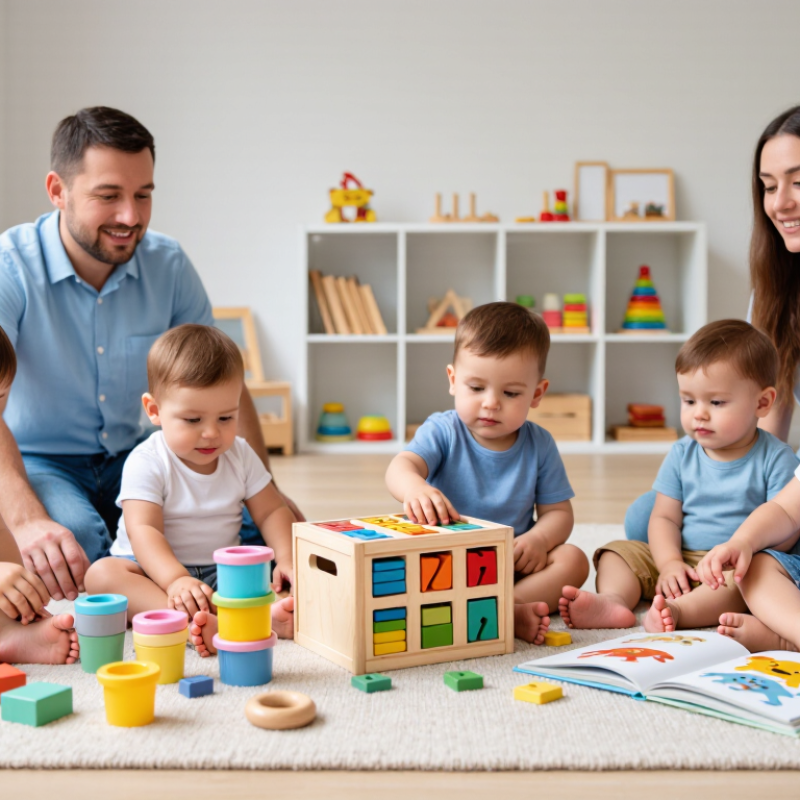
The best early-learning toys invite babies to touch, move, listen, and repeat. Textured balls support grasping and hand strength. Soft rattles encourage reaching and tracking sounds. Stacking cups build coordination, while nesting blocks introduce size and balance. Cloth books support language through pictures, textures, and shared reading. These simple toys often teach more than noisy electronic products.

Toddlers benefit from shape sorters, chunky puzzles, push-and-pull toys, activity boards, and large building blocks. Shape sorters develop problem-solving and wrist control. Push toys can encourage walking practice when used on a stable surface. Building blocks strengthen planning, but towers will fall. That is useful feedback. Water-play cups also support pouring and early science concepts, with close adult supervision.

From my experience observing young children, interest matters more than toy quantity. A baby may ignore a carefully chosen puzzle and prefer a wooden spoon. That response is normal. Pediatric occupational therapy guidance commonly emphasizes safe repetition, free movement, and age-appropriate challenges. Choose toys without small detachable parts, sharp edges, or loose strings. Check them regularly for damage. Adults should play nearby, name actions, and allow pauses. I sometimes give too much help, then notice the child loses interest. Waiting a few seconds can create space for independent discovery.

Top Toys for Language, Thinking, and Problem-Solving Skills

10 Best Educational Baby and Toddler Toys?

The best early-learning toys invite conversation, movement, and small discoveries.

  • Picture books support naming, pointing, and turn-taking.
  • Stacking cups teach size, balance, and simple prediction.
  • Large blocks encourage planning, while shape sorters develop matching and problem-solving.
  • Nesting toys add sequencing.
  • Simple puzzles strengthen visual reasoning.
  • Pretend food and animal figures expand vocabulary through everyday stories.
  • Musical shakers help children notice rhythm, volume, and cause and effect.
  • Matching cards build memory when adults play patiently.
  • Push-and-pull toys support spatial awareness and early motor planning.

Play matters more than toy quantity. The American Academy of Pediatrics states that play supports language, executive function, and social development in its clinical report, The Power of Play. CDC developmental guidance for two-year-olds includes combining at least two words and noticing objects in books. That makes books and conversation practical learning tools, not decoration.

Ask, “Where is the red cup?” Then wait. Silence helps.

The World Health Organization’s 2019 guidelines recommend no sedentary screen time for infants and no more than one hour daily for two-year-olds. Hands-on toys offer a useful alternative.

Still, I sometimes expect too much from a clever puzzle. A toddler may only stack the pieces or abandon it quickly. That is not failure. Observe the child, simplify the task, and join the play without taking control.

Some toys seem educational but create little conversation. A cardboard box can work better.

Age-Based Guide to Choosing the Right Educational Toys

For babies aged zero to six months, choose high-contrast picture cards, soft sensory balls, and textured teethers. These toys support visual tracking, grasping, and early hand awareness. Keep every piece large enough to prevent choking. A caregiver should inspect seams and surfaces often.

From six to twelve months, nesting cups, stacking rings, and sturdy cloth books encourage coordination and simple problem-solving. Babies may knock everything down repeatedly. That is useful learning, not failure. Between twelve and twenty-four months, try chunky puzzles, shape sorters, and large building blocks. These activities develop matching skills, spatial awareness, and controlled movement. Sit nearby and name colors, shapes, and actions without demanding perfect answers.

For toddlers aged two to three years, pretend food sets and washable water-play tools support language, planning, and social practice. A simple matching game can teach memory through familiar objects, such as socks or animal pictures. Choose toys with clear instructions, rounded edges, and non-toxic materials from reliable safety-tested sources. Avoid toys with loose magnets, accessible button batteries, or tiny detachable parts. Children do not always use toys as intended. A stacking cup may become a drum, and that creative detour matters. I have found that fewer toys often invite longer play, although some children need more variety. Observe the child’s interest, frustration, and emerging abilities before moving to a harder challenge.

10 Best Educational Baby and Toddler Toys? - Age-Based Guide to Choosing the Right Educational Toys

No. Toy Type Recommended Age Primary Learning Benefits Key Skills Practiced How to Use It Educationally Important Safety Notes
1 Textured Grasping Ball 0–6 months Encourages sensory exploration and early visual tracking. Grasping, reaching, hand-eye coordination, tactile awareness Place the ball within easy reach and describe its texture, color, and movement. Use a large, one-piece design without detachable parts. Stop use if damaged.
2 Soft Cloth Activity Book 0–12 months Introduces pictures, sounds, textures, and early communication. Listening, visual attention, sensory discrimination, vocabulary development Name the pictures, imitate sounds, and let the child turn or touch the pages. Check that ribbons, mirrors, and stitching are securely attached. Use only while supervised.
3 Stacking Cups 6–18 months Builds early understanding of size, order, and cause and effect. Fine-motor control, problem-solving, spatial reasoning, counting Stack from largest to smallest, nest the cups, and count them aloud. Choose cups too large to fit completely in a child’s mouth and free from sharp edges.
4 Large Interlocking Blocks 12–24 months Supports construction play, creativity, and early engineering concepts. Coordination, planning, balance, persistence, imaginative thinking Build towers, compare tall and short structures, and discuss why a tower falls. Select oversized pieces designed for toddlers; inspect regularly for cracks or broken connectors.
5 Shape-Sorting Box 12–24 months Introduces matching, classification, and basic geometric awareness. Visual discrimination, hand-eye coordination, reasoning, persistence Name each shape and color, then encourage trial and error without taking over. Use large shapes with no small pieces. Avoid forcing pieces through an opening.
6 Chunky Wooden Puzzle 18–30 months Develops visual matching and an understanding of part-to-whole relationships. Fine-motor precision, memory, concentration, spatial reasoning Start with simple puzzles and discuss the objects, colors, and shapes shown. Pieces should be large, smooth, and free from splinters, loose knobs, or peeling finishes.
7 Push-and-Go Vehicle 12–30 months Demonstrates motion, direction, distance, and simple cause and effect. Gross-motor movement, coordination, prediction, early physics concepts Push the vehicle on different surfaces and use words such as fast, slow, near, and far. Avoid long cords, pointed axles, and small removable wheels. Use on a clear floor area.
8 Simple Musical Shaker 12–30 months Encourages rhythm, listening, imitation, and expressive movement. Auditory attention, timing, bilateral coordination, self-expression Create slow and fast rhythms, take turns, and sing simple repetitive songs. Use a sealed, durable instrument and keep volume moderate to protect hearing.
9 Play Food and Pretend Kitchen Set 24–36 months Strengthens language, social understanding, and everyday-life concepts through role play. Vocabulary, sequencing, cooperation, symbolic thinking, fine-motor skills Pretend to shop, sort foods by type, and describe preparing or sharing a meal. Choose oversized pieces without magnets, sharp edges, or small detachable accessories.
10 Washable Drawing Board 24–36 months Provides a low-mess introduction to marks, symbols, and early writing movements. Hand control, visual expression, creativity, pre-writing development Practice lines, circles, and simple pictures while talking about the marks being made. Use only writing tools intended for the product. Check that the stylus is securely attached or sufficiently large.

Selection tip: Choose toys that match the child’s current abilities, encourage active interaction, and carry clear age and safety guidance. Adult supervision is recommended, especially for children under three.

Safety, Durability, and Play Value When Selecting Toys

10 Best Educational Baby and Toddler Toys?

Safe toy selection begins with the child’s age, abilities, and daily habits. In my experience, age labels help, but they cannot replace supervision. Check every toy for loose parts, sharp edges, peeling paint, and damaged seams. Avoid accessible button batteries, small magnets, and pieces that fit completely inside a child’s mouth. Babies explore with their mouths. That changes everything.

Strong educational choices include stacking cups, chunky blocks, nesting toys, shape sorters, and simple puzzles. Textured balls support grasping and movement. Picture books encourage early language.

Pretend food builds vocabulary and social play. Musical shakers develop listening and rhythm. Push toys can support balance when a toddler is ready.

These ten categories offer different kinds of learning without requiring complicated instructions. Open-ended toys often create more play value than flashy toys with one fixed function.

Durability matters because toddlers drop, chew, wash, and sometimes throw toys. Choose solid construction, smooth surfaces, non-toxic finishes, and materials that can be cleaned easily. Inspect frequently, especially after rough play. A toy may be safe today and damaged tomorrow.

I have sometimes valued bright colors too much and overlooked how quickly a design becomes frustrating. Children need challenge, but they also need success.

A sturdy toy that invites repeated handling may teach more than an impressive toy used once. During play, watch for fatigue, broken parts, or changes in interest. Five quiet minutes can reveal a lot.

FAQS

What makes a baby or toddler toy educational?

It encourages the child to act, notice, experiment, and try again. Letters and flashing lights are not enough. Simple play can be powerful.

Which toys support learning for babies aged zero to six months?

Choose high-contrast cards, soft sensory balls, and textured teethers. These support visual tracking, grasping, and hand awareness. Check seams often.

What toys suit babies aged six to twelve months?

Nesting cups, stacking rings, and sturdy cloth books build coordination. Babies may knock everything down repeatedly. That is useful learning.

Which toys work well for toddlers aged twelve to twenty-four months?

Try chunky puzzles, shape sorters, and large building blocks. They support matching, spatial awareness, and controlled movement. Name colors and actions nearby.

What are useful toys for children aged two to three?

Pretend food, washable water tools, and simple matching games encourage language and planning. Familiar socks or animal pictures can make matching meaningful.

Are open-ended toys always educational?

No. Open-ended toys offer many actions, but some frustrate small hands. Observe the child’s interest, fatigue, and attempts before choosing harder challenges.

How can adults improve learning during toy play?

Stay nearby and describe actions with words like “inside,” “rough,” or “higher.” Shared conversation adds value. The toy cannot replace responsive interaction.

What safety features should parents check?

Avoid loose magnets, accessible button batteries, sharp edges, peeling paint, and tiny detachable parts. Every piece should be too large to swallow. Inspect toys after rough play.

Are electronic or screen-based toys better than ordinary toys?

Not usually. Real objects provide touch, movement, and conversation. Screen use should remain limited, especially for very young children. Less can be better.

How can parents choose toys that last?

Look for smooth surfaces, sturdy construction, washable materials, and non-toxic finishes. Toddlers drop, chew, and sometimes throw toys. I used to value bright colors too much.

Conclusion

Educational Baby & Toddler Toys support children’s growth through meaningful, age-appropriate play. The best toys encourage early sensory and motor development by engaging touch, sight, hearing, reaching, grasping, stacking, and movement. They also help build language, thinking, and problem-solving skills through simple activities such as naming objects, matching shapes, exploring cause and effect, and practicing basic turn-taking. A truly educational toy does not need to be complicated; it should invite curiosity, active participation, and repeated discovery.

Choosing the right toy depends on a child’s developmental stage, interests, and abilities. Babies may benefit from soft, easy-to-hold objects with varied textures, while toddlers can explore puzzles, sorting activities, building pieces, and pretend-play materials. Safety and durability are essential, so caregivers should look for sturdy construction, child-safe materials, suitable sizes, and clear age guidance. Toys with lasting play value are especially useful because they can support new skills as children grow.

Nathaniel

Nathaniel

Nathaniel is a dedicated marketing professional with a strong understanding of the company’s products, industry trends, and customer needs. Through years of experience in market research, content strategy, and professional communications, he translates complex product information into clear,......